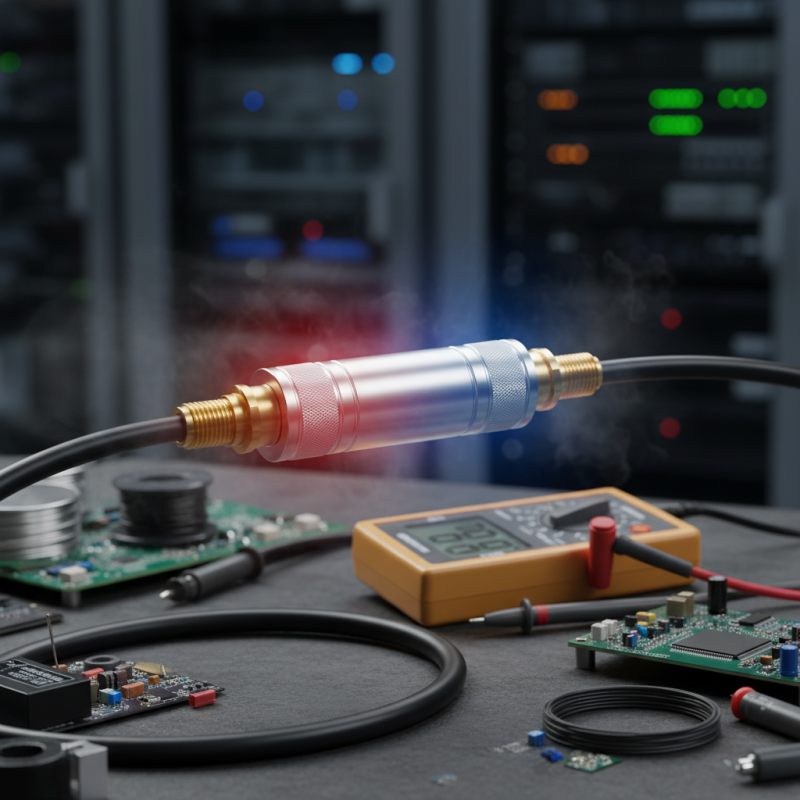
What is a Coaxial Attenuator and How Does it Work?
A Coaxial Attenuator is a crucial device in the world of signal transmission. It helps manage signal strength in coaxial cable systems. These systems are common in communication networks. An attenuator reduces the signal amplitude, preventing distortion or interference.
Understanding how a Coaxial Attenuator works can be complex. It involves resistive elements that dissipate energy as heat. This process ensures that signals remain clear over long distances. Installations may require specific calculations to determine the appropriate attenuation level.
Despite their usefulness, issues can arise. Incorrectly chosen attenuators may lead to signal loss or degradation. It's important to reflect on the requirements of your specific application. Making informed decisions can improve performance significantly. The role of a Coaxial Attenuator shouldn't be underestimated in maintaining quality.
What is a Coaxial Attenuator and Its Key Characteristics?
A coaxial attenuator is a passive device that reduces signal strength. It is typically used in RF (radio frequency) applications. These devices manage signal levels, preventing distortion. They come in various designs, such as fixed and variable types, each serving a unique purpose.
Key characteristics include frequency range, power rating, and insertion loss. The frequency range determines how well the attenuator performs in different scenarios. The power rating indicates how much power the device can handle without damage. Insertion loss is a crucial factor; it measures how much signal loss occurs when the attenuator is in the circuit.
It's important to note that improper selection could lead to poor performance. Users must consider their specific needs carefully. Over-attenuation can weaken the signal too much, rendering it ineffective. Hence, thoughtful application is crucial, as a poorly chosen attenuator may not fulfill its intended function. The balance between attenuation and maintaining signal integrity is a delicate one.
Principles of Operation: How Coaxial Attenuators Function
Coaxial attenuators play a vital role in managing signal strength. They are widely used in various communication systems. These devices help control the power of the signals transmitted through coaxial cables. By doing this, they prevent distortion and improve clarity.
The operation of coaxial attenuators relies on resistive elements. When a signal passes through, some energy is absorbed. This absorption reduces the signal's amplitude. As a result, the power is lowered without significantly altering the waveform. It's fascinating to note how these components maintain a balance. They ensure that the transmitted information remains accurate despite the reduction.
Understanding the design is equally important. Coaxial attenuators come in various configurations. Some offer fixed attenuation levels, while others are adjustable. The choice often depends on specific needs. It's important to choose the right type to match the system's requirements. However, what if the attenuation is too high? This can lead to signal loss and inefficiencies. Making informed decisions is essential for optimal performance.
What is a Coaxial Attenuator and How Does it Work? - Principles of Operation
| Parameter | Description | Typical Values |
| Frequency Range | The range of frequencies over which the attenuator operates effectively. | DC to 18 GHz |
| Impedance | Characteristic impedance that the attenuator is designed to match. | 50 Ohms or 75 Ohms |
| Attenuation Level | The amount of signal reduction provided by the attenuator. | 1 dB to 30 dB |
| Power Handling | Maximum power the attenuator can handle without damage. | 1 W to 200 W |
| Connector Type | Type of connector used to interface with other equipment. | N-Type, BNC, SMA, etc. |
| Temperature Range | Operating temperature range of the device. | -40°C to +85°C |
Types of Coaxial Attenuators: Fixed vs. Variable Attenuation
Coaxial attenuators are critical in RF applications. They manage signal strength, ensuring optimal performance across devices. The two main types of coaxial attenuators are fixed and variable attenuation. Each serves a unique purpose in various environments.
Fixed attenuators provide a consistent level of attenuation. They are designed for situations where uniformity is essential. For example, in testing settings, a fixed attenuator delivers reliable results. Data shows that using fixed attenuators can enhance system stability by as much as 30%. However, they lack flexibility and can lead to unwanted signal loss if not properly matched.
On the other hand, variable attenuators offer adjustability. This flexibility allows users to tailor attenuation levels in real-time. It is valuable for different testing scenarios or adapting to signal fluctuations. Industry reports indicate that variable attenuators can reduce signal distortion by approximately 20%. Yet, they can introduce additional complexity. Users need to ensure proper calibration to avoid unexpected performance issues. Each type plays a crucial role, but the choice depends on specific application needs.
Applications of Coaxial Attenuators in RF and Microwave Systems
Coaxial attenuators play a crucial role in RF and microwave systems. These devices help manage signal strength, ensuring optimal performance in various applications. For instance, they're commonly used in communication systems to reduce signal levels without substantial distortion. According to industry reports, the RF and microwave market is expected to reach USD 20 billion by 2026, highlighting the growing importance of these components.
In testing environments, coaxial attenuators are essential. They allow engineers to calibrate devices and assess performance metrics accurately. By adjusting signal levels, users can mitigate issues like interference. Some studies show that improper signal strength can lead to a 30% drop in efficiency. This emphasizes the need for precise attenuation in sensitive applications, like satellite communications and radar systems.
Medical imaging is another area where coaxial attenuators serve a vital role. They help maintain consistent signal quality in MRI and ultrasound equipment. Variations in signal can affect diagnostic accuracy. Research indicates that a 10 dB change in attenuation can impact image clarity significantly. Thus, choosing the right attenuator becomes imperative for reliable outcomes.
Important Specifications: Power Rating and Frequency Response Standards
Coaxial attenuators are crucial components in RF and microwave applications. They help reduce signal power without distorting the signal shape. Two important specifications to consider are power rating and frequency response standards.
The power rating indicates the maximum power the attenuator can handle. Common ratings range from a few milliwatts to hundreds of watts. Selecting the right power rating is vital. Exceeding it can lead to overheating and damage. For instance, a 10-watt attenuator can effectively manage signals within its limit.
Frequency response is also essential. It defines how the attenuator performs across a range of frequencies. Typical coaxial attenuators operate well from DC to several GHz. Ideally, an attenuator should maintain its specified attenuation level across the desired frequency range. Deviations can lead to unwanted signal loss.
Tips: When selecting an attenuator, check power rating carefully. It’s better to choose one with a higher rating to avoid thermal issues. Additionally, measure your system's frequency requirements. Don’t overlook real-world performance tests, as specifications might not reflect actual use.
Be cautious. Some users underestimate the importance of these specifications. This can lead to poor system performance and signal integrity issues later on. Always double-check your choices and consider unforeseen variables in your setup.