How to Choose the Right Injection Machine Robot for Your Needs?
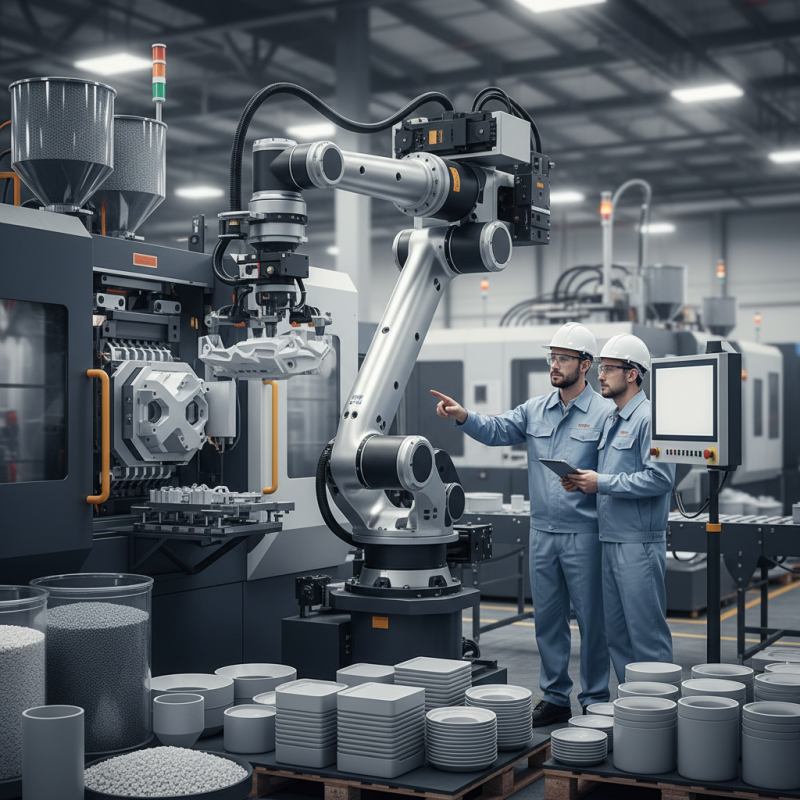
Choosing the right Injection Machine Robot involves careful consideration of many factors. These machines play a crucial role in manufacturing processes, enhancing efficiency and precision. However, selecting the best robot can be challenging.
One must consider specific needs and requirements. What type of materials will you be processing? How complex is the injection molding design? Knowing this can significantly influence your choice. Additionally, think about the production volume. A robot that suits one factory may not be ideal for another.
Avoid rushing the decision. Evaluate the features of different Injection Machine Robots. Some might promise advanced functions but may not deliver in real-world scenarios. Identify what operations are most critical for your production line. Being thoughtful and strategic can lead to better outcomes.
Understanding Injection Machine Robots and Their Applications
Injection machine robots play a vital role in manufacturing. They automate the injection molding process. This improves precision and speed. According to a market research report by Mordor Intelligence, the global injection molding market is expected to reach USD 438 billion by 2027. This growth indicates a rising reliance on automation.
Understanding the applications of these robots is crucial. They are used in various sectors, including automotive, electronics, and consumer goods. The automotive industry alone accounts for roughly 30% of all injection molding applications. Companies increasingly seek efficiency while managing costs.
However, choosing the right robot can be challenging. Factors like load capacity and cycle time are critical. Inadequate assessment may lead to inefficient operations. A report by Grand View Research suggests that over 40% of manufacturing companies faced operational issues due to poor equipment choices. It's essential to evaluate needs thoroughly.
How to Choose the Right Injection Machine Robot for Your Needs?
| Feature | Description | Application | Load Capacity (kg) | Speed (mm/sec) |
| Articulated Robot | High flexibility, ideal for complex tasks | Injection molding, assembly | 20 | 150 |
| Delta Robot | High speed and accuracy, great for packaging | Pick and place, sorting | 10 | 300 |
| SCARA Robot | Good for high-speed operations with limited vertical movement | Assembly, packaging | 15 | 200 |
| Cartesian Robot | Simple design, ideal for repetitive tasks | Material handling, assembly | 25 | 100 |
Key Factors to Consider When Choosing an Injection Machine Robot
Choosing the right injection machine robot can be challenging. Focus on key factors that influence your decision. One essential aspect is the size of your operation. A compact robot may be suitable for small-scale production. In contrast, a larger scale might require a more robust system.
Another critical factor to consider is the type of materials you will use. Different robots handle various materials differently. Ensure the robot you choose can process your specific materials effectively. Additionally, speed and precision are vital in production. The right robot should not only meet your speed requirements but also provide consistent accuracy.
Don't overlook maintenance needs, either. Some robots require more frequent upkeep. Consider how much time and money you can allocate for maintenance. Reflecting on these factors can help you narrow down your options. Ultimately, each choice you make might lead to different outcomes, so thorough research is essential.
Types of Injection Machine Robots and Their Unique Features
When selecting an injection machine robot, understanding the types available is crucial. There are a few main categories, each designed for specific tasks. Cartesian robots are known for their precision in pick-and-place applications. They utilize linear movement along X, Y, and Z axes. This makes them suitable for simple, repetitive tasks. However, their limitation lies in flexibility for complex operations.
Another type is the SCARA robot. Its unique arm design allows for rotational movement, making it ideal for assembly tasks. These robots excel in speed and efficiency. But, they may struggle with heavy loads. The 6-axis robots are great for intricate movements and can reach almost any point in three-dimensional space. Their versatility is impressive, but they require more complex programming and setup time.
Each type has unique features but also drawbacks. Choosing the right one involves assessing your production line's specific needs. Considerload capacity, speed requirements, and workspace constraints. Some companies invest in the latest models but overlook essential factors. This can lead to inefficiencies. Remember that the best robot isn’t always the most advanced; it’s the one that fits your special circumstances.
Assessing Your Production Needs and Robot Compatibility
When considering the right injection machine robot for your production, the first step is to assess your specific needs. What types of products do you manufacture? How complex are the parts? These questions are crucial. If your production involves intricate designs, a more sophisticated robot might be necessary. Simpler products may only require a basic machine.
Compatibility with your existing systems is another key factor. Consider how the robot integrates with your current injection molding processes. Will it improve speed and efficiency? Or will it complicate your workflow? It’s important to ensure a seamless integration. Sometimes, what seems like a perfect fit may actually disrupt the flow.
Furthermore, evaluate the future scalability of your operations. Do you anticipate growth in production volume? If so, select a robot that can adapt to changes in demand. Reflecting on your long-term goals will guide your decision-making process. Overlooking this aspect can limit your operational capabilities down the line.
Evaluating Budget and Return on Investment for Robot Selection
Choosing the right injection machine robot involves careful consideration of your budget and potential return on investment. Establish a clear budget before diving into the selection process. This means considering not only the upfront cost of the robot but also ongoing operational expenses. Factor in maintenance costs, parts replacement, and energy consumption. Look for a balance between price and quality; sometimes, a lower-priced machine may end up costing more in the long run due to poor durability or inefficiency.
Return on investment is another critical aspect. Analyze how the robot will improve productivity in your operations. Will it reduce cycle times? Increase precision? Every robot should add value to your processes. Talk to operators and engineers to gather insights. Their experiences can reveal unseen costs or benefits. Sometimes, an initial high investment can lead to significant long-term savings. However, be cautious; these decisions require reflection. A thorough evaluation can prevent costly missteps and drive your operations toward greater efficiency.
Comparison of Injection Machine Robot Types for Budget and ROI Evaluation