
Top Door Sensor Switch for Global Buyers How to Choose?

Choosing the right Door Sensor Switch is less about finding the lowest quotation. It is about matching sensing technology, installation conditions, and long-term reliability.

Industry reports show why this category deserves closer evaluation. MarketsandMarkets identifies smart sensors as a fast-growing part of connected buildings, driven by automation, safety monitoring, and energy management. ABI Research also reports continuing investment in access-control devices that combine local sensing with wireless communication. However, these studies usually group door sensors with broader smart-home or security equipment. Their figures cannot perfectly describe every Door Sensor Switch application. That limitation matters.

Bruce Schneier, a widely recognized security technologist, has said, “Security is a process, not a product.” His point applies directly to door sensing. A switch that performs well in a clean showroom may fail near dust, vibration, condensation, or repeated impact. Buyers should examine contact type, IP rating, operating temperature, switching load, wireless protocol, battery life, and integration with alarms or building-management systems. Test the actual door.

A reliable selection process also requires supplier evidence. Look for clear datasheets, traceable test results, sample validation, warranty terms, and documented quality controls. A magnetic reed switch may suit a light interior door. An industrial Hall-effect sensor may perform better where mechanical wear is a concern. Neither choice is universally superior. That is the uncomfortable part. Global buyers must compare real operating conditions, not attractive catalog language. The best Door Sensor Switch is the one that remains dependable after thousands of openings, imperfect installation, and changing site conditions.
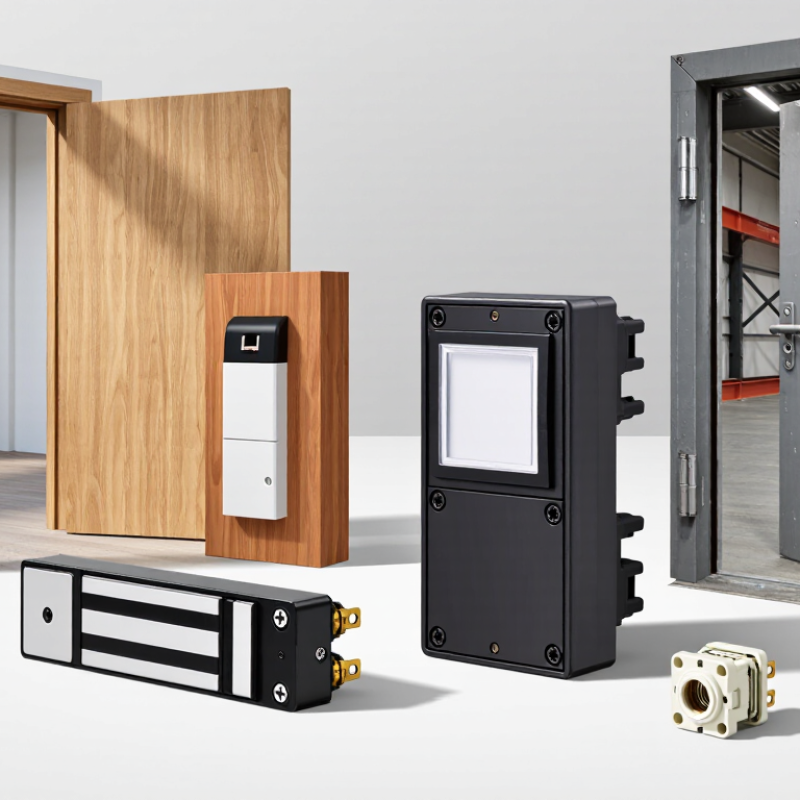
Top Door Sensor Switch for Global Buyers How to Choose?

Define Door Sensor Types: Reed, Hall-Effect, Inductive, and Optical

Choosing a door sensor starts with its sensing principle, not its advertised range.

IoT Analytics reported 16.6 billion connected IoT devices worldwide at the end of 2023. That scale increases demand for reliable, compact inputs.

Reed switches use a magnet and sealed contacts. They are simple, low-power, and economical. Mechanical wear remains a concern.

Hall-effect sensors detect magnetic fields electronically, so they avoid contact wear. They suit frequent cycling and tamper-aware designs. However, nearby magnets or steel surfaces can alter the switching point.

Small errors matter.

Inductive sensors detect metal targets without physical contact. They perform well in dusty industrial door frames. They usually consume more power than reed devices.

Optical sensors use an emitter and receiver to detect interruption or reflection. They can identify open gaps precisely, but dust, sunlight, and condensation may reduce reliability.

The IEC 60529 IP rating helps compare enclosure protection, yet it does not guarantee field performance. A 2024 IoT Analytics report also highlights growing device diversity, which makes interface testing increasingly important.

Test the actual door, frame, cable length, and temperature range. Do not trust laboratory distance alone.

I would also question whether the cheapest reed sensor remains economical after repeated maintenance. Threshold drift is easy to overlook.


Match Electrical Ratings to IEC 60947-5-2 and Your Control System

Top Door Sensor Switch for Global Buyers: How to Choose?

IEC 60947-5-2 mainly covers proximity switches, not every door sensor switch. That distinction matters. For mechanical or magnetic door devices, also check IEC 60947-5-1 and ISO 14119 where safety guarding applies. A professional selection begins with the control circuit, not the product photograph.

Match the switch rating to the real load. Record voltage, current, utilization category, switching frequency, and environmental temperature. AC-15 and DC-13 loads can stress contacts differently. A 24 VDC PLC input may accept a sensor, yet leakage current can prevent a clean OFF signal. Check voltage drop, residual current, polarity, and PNP or NPN compatibility. Short-circuit protection is essential. So is it.

The industrial sensors market was valued at about USD 27.5 billion in 2023, according to Grand View Research’s 2024 market report. MarketsandMarkets also forecasts strong growth through 2028, driven by factory automation and connected equipment. These figures show demand, not guaranteed reliability. I have seen installations fail because engineers matched nominal voltage while ignoring inductive loads and cable length. Test the complete circuit at cold start, normal operation, and maximum temperature. Leave rating margin. It is often forgotten. When specifications conflict, request the original test conditions and conformity documents before purchasing.

Top Door Sensor Switch for Global Buyers: Match Electrical Ratings to IEC 60947-5-2 and Your Control System

The chart shows common nominal control-system supply voltages used in international industrial installations. Before selecting a door sensor switch, confirm that its rated operational voltage (Ue), rated operational current (Ie), AC/DC type, switching category, and load compatibility match the control system. These voltage levels are reference values, not universal sensor ratings; always verify the product datasheet and the applicable IEC 60947 requirements.

Select IP Protection from IP54 to IP69K Under IEC 60529

Choosing a door sensor switch starts with its environment, not its appearance. The IP rating follows IEC 60529 and contains two digits. The first measures protection against solid objects and dust. The second measures resistance to water.

IP54 suits indoor doors exposed to limited dust and occasional splashes. IP65 offers dust-tight protection and resistance to water jets. IP66 handles stronger water jets, while IP67 supports temporary immersion. IP68 may support longer immersion, but the tested depth and duration must be stated. Details matter.

For washdown areas, IP69K is often considered. It indicates resistance to high-pressure, high-temperature spray. However, buyers should check the actual test standard. IP69K may reference ISO 20653 or related testing, while IEC 60529 commonly uses IPX9. A label alone is not enough. Request the test report, gasket material, cable-entry method, and installation instructions. A poor cable seal can reduce real protection quickly.

In field checks, I look for dust around the actuator and moisture inside the housing. Small gaps reveal problems. Also consider temperature, chemicals, vibration, and door movement. A switch rated IP69K may still fail if its cable bends sharply or its mounting surface is uneven. I have seen specifications that looked excellent but ignored the connector. That mistake is easy to repeat. Select the lowest rating that safely matches the site, then verify the complete installed assembly.

Verify Safety Performance with ISO 13849-1 PL Requirements

Top Door Sensor Switch for Global Buyers: How to Choose?

For industrial doors, select a sensor switch by the required safety function, not by appearance alone. ISO 13849-1 evaluates the complete control system through Performance Level, from PL a to PL e. A sensor is only one part. The controller, wiring, diagnostics, and actuator must work together.

Check whether the risk assessment requires PL c, PL d, or PL e. Then review MTTFd, diagnostic coverage, and common cause failure measures. A dual-channel circuit may improve fault detection, but it needs suitable monitoring. The switch should detect forced opening, wiring faults, and contact welding where required. Small gaps matter. Confirm the coded operating distance with the actual guard design.

Environmental details also affect reliability. Inspect IP protection, temperature range, vibration resistance, and chemical exposure data. A door near coolant spray needs different protection from one inside a clean assembly area.

During validation, test misalignment, slow opening, broken wires, and repeated cycling. Do not accept a supplier’s PL statement without checking its scope and technical file.

The final PL belongs to the validated safety function, not automatically to the switch.

In practice, paperwork can look complete while installation errors remain. That is where careful testing matters.

Compare Detection Range, Switching Cycles, Wiring, and Total Cost

Choosing a door sensor switch starts with the detection range, not the lowest price. For magnetic models, a practical working gap is often 5–15 mm, but metal frames can reduce it sharply. Test the switch on the actual door, including slight sag and vibration. The 2024 Global Smart Home Market report by MarketsandMarkets forecasts strong double-digit growth through 2028, increasing demand for reliable retrofit sensors. More installations also expose weak specifications.

Switching cycles deserve careful attention. A basic contact may handle 100,000 operations, while industrial designs can exceed one million, depending on load and enclosure conditions. IEC 60947-5-1 emphasizes electrical rating, utilization category, and protective design rather than a single universal cycle number. Therefore, compare cycle figures under the same voltage and current. A claim without test conditions is incomplete. Very incomplete.

Wiring changes the total cost. Two-wire normally-closed circuits are simple for alarm inputs, while three-wire or four-wire versions may support monitoring and diagnostics. Check cable length, connector access, ingress protection, and replacement labor. The U.S. Department of Energy’s 2023 buildings report shows controls and sensors can reduce operational energy use, but savings depend on correct commissioning. My first cost estimate often misses drilling, brackets, testing, and service visits. Calculate purchase price, installation time, expected cycles, failure risk, and downtime over five years.

REQUEST A QUOTE

Menu
[all-fields]